We interviewed Professor Amano with the following 6 questions:
This interview took place on December 6th, 2025.
1. What motivated you to start this research?
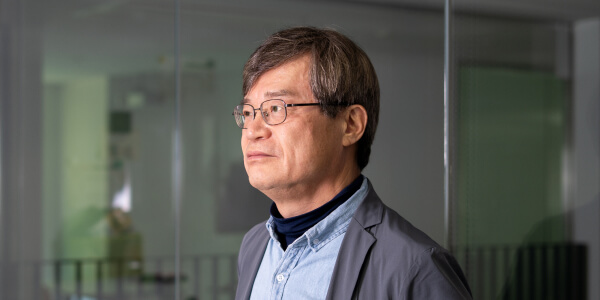
That was my undergraduate research project. Back in high school, Bill Gates had just founded Microsoft. When I entered Nagoya University, I was obsessed with computer technology. “Wow, I can make my own Space Invaders game with a microcomputer!”. At that time, Nagoya University had no research laboratories dedicated to microcomputers. However, when I saw the undergraduate research theme, “Gallium Nitride (GaN) based blue LEDs” in the Akasaki Laboratory, I though, “This is it!”. Red and green LEDs were already commercialy available. Therefore, if I could make a blue LED, we could realized flat panel displays using the three primary color LEDs, and that would change the world. All children today are natives of flat-screen displays, and I'm sometimes surprised by what they take for granted.
2. What research topic are you currently focusing on?
All of our current research themes involve GaN. First, as an optoelectronic device, we have developed a DUV laser diode with an extremely short wavelength. Second, in power semiconductors, we aim to leverage lightweight and miniaturization technologies for applications not only in electric vehicles but also in electric aircraft and ships.
As another applications, we are currently advancing the development of high-frequency devices. For example, while we currently operate smartphones with our hands, an era where we can connect to the internet using only glasses may become a reality. Furthermore, if we can control wavelengths up to the THz range, the convenience it could bring to our lives is unimaginable. Such devices could diagnose health conditions without special examinations, potentially making something like the stethoscope from ‘Star Trek’ a reality.
3. Based on your past experiences, do you have any messages or lessons you'd like to share with young researchers or companies? I'd love to hear them.
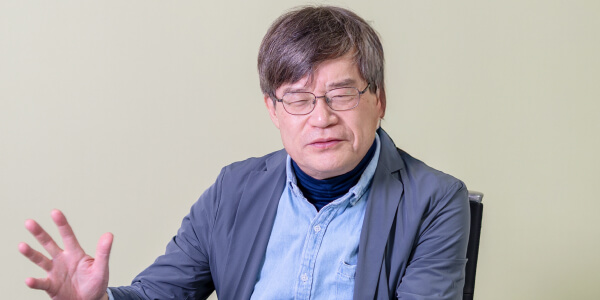
What is important when doing things that benefit human society? Professor Shinya Yamanaka answered this question: “VW. Not Volkswagen. V stands for VISION, W stands for WORK HARD.” Find what you truly want to do. The effort you put into that pursuit becomes your VISION. After that, WORK HARD relentlessly and never give up. Seeing it through to the end is most important. This applies not only to young people but also to companies.
Creating your own VISION is not easy. Right now, I'm working with many students on activities aimed at solving social issues. They are the kind of people who can propose business models to investors and private companies as “solutions to social issues.”
4. It's been 11 years since you won the Nobel Prize. Compared to then, have anything changed in your lifestyle or state of mind?
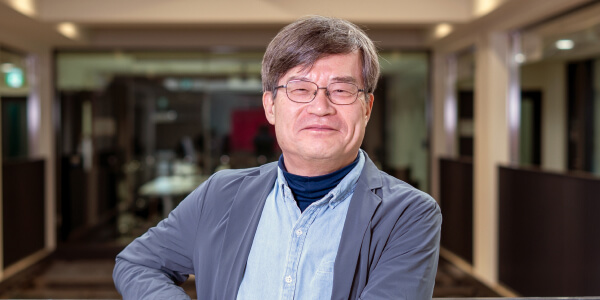
My lifestyle hasn't changed at all. I go to university from the beginning of the year to the end, just hanging around. It's no different from before.
Recently, I visited Moldova at the invitation of an academy. Not long ago, I also visited Oman and Guatemala. While there, I engaged in discussions with students.
When I was a student, semiconductor research only went as far as crystal growth. In 1984, we built a handmade MOCVD reactor. Back then, we didn't worry much even if combustible substances like metal organic compounds or gases leaked. Now, we install proper exhaust systems to ensure safety. Now, we can complete the entire process: from epitaxial growth to device fabrication, assembling them into circuits and modules, and finally operating the system. This might be a benefit of winning the Nobel Prize.
5. Regarding work-life balance, how do you spend your time off? Do you have any tips for refreshing yourself?
It's a difficult question to answer. For me, work is life, and life is work. Being in the lab is my way of relieving stress.
6. Finally, some hopeful advice for MOCVD.
Professor Russell Dupuis of Georgia Institute of Technology has received the Japan Prize. Professor Dupuis initially engaged in solar cell research as a pioneer of the world's first MOCVD equipment. He stated, “MOCVD is like a Swiss Army knife; it can produce everything from blue LEDs and lasers for optical communications to HEMTs for wireless and satellite communications. I believe these potential holds even broader application fields.”
A Cornell University student collaborating with us said, “Using MOCVD technology, such as deposition of lanthanum oxide or hafnium oxide as ferroelectrics on GaN, dramatically improves performance.” Starting with MBE, after the device functions, mass production is achieved via MOCVD. In recent years, many researchers world wide have been enthusiastic about researching advanced oxide films. MOCVD contributes to building various social infrastructures like optical communications, the internet, smartphones, and lighting. We hope MOCVD technology continues to expand its global market presence.
I think this potential has a much broader range of applications. A student from Cornell University recently visited us and said that adding rare earth elements (such as lanthanum and hafnium) to oxides using MOCVD can dramatically improve performance. They start with MBE, and once the device works, they use MOCVD for mass production. The United States is very enthusiastic about researching new oxides. MOCVD contributes to various social infrastructures, including optical communications, the Internet, smartphones, and lighting. I hope the market will expand globally.
For products related to this interview, please check this page.
Products & Materials
AMANO Hiroshi
Graduated from the Department of Electronic Engineering, Nagoya University in 1983.
Professor at Nagoya University in 2010.
Awarded the Nobel Prize in Physics along with Isamu Akasaki and Shuji Nakamura for his research on blue LEDs in 2014.
Since 2015, director and professor at CIRFE, Nagoya University. Participated in NEDO projects such as "Development of fundamental technologies such as nitride semiconductors to realize next-generation lighting, etc. 2009-2013“.